
New National Data Finds Disengagement, Not Violence, Is Top School Concern
Recent data challenges the assumption that schools are in a safety crisis. The real 2026-27 problem is quiet
Press Release Disclaimer: This is a press release distributed through the XPR Media network. It has not been independently verified by our newsroom.

Recent data challenges the assumption that schools are in a safety crisis. The real 2026-27 problem is quiet disengagement, not danger.
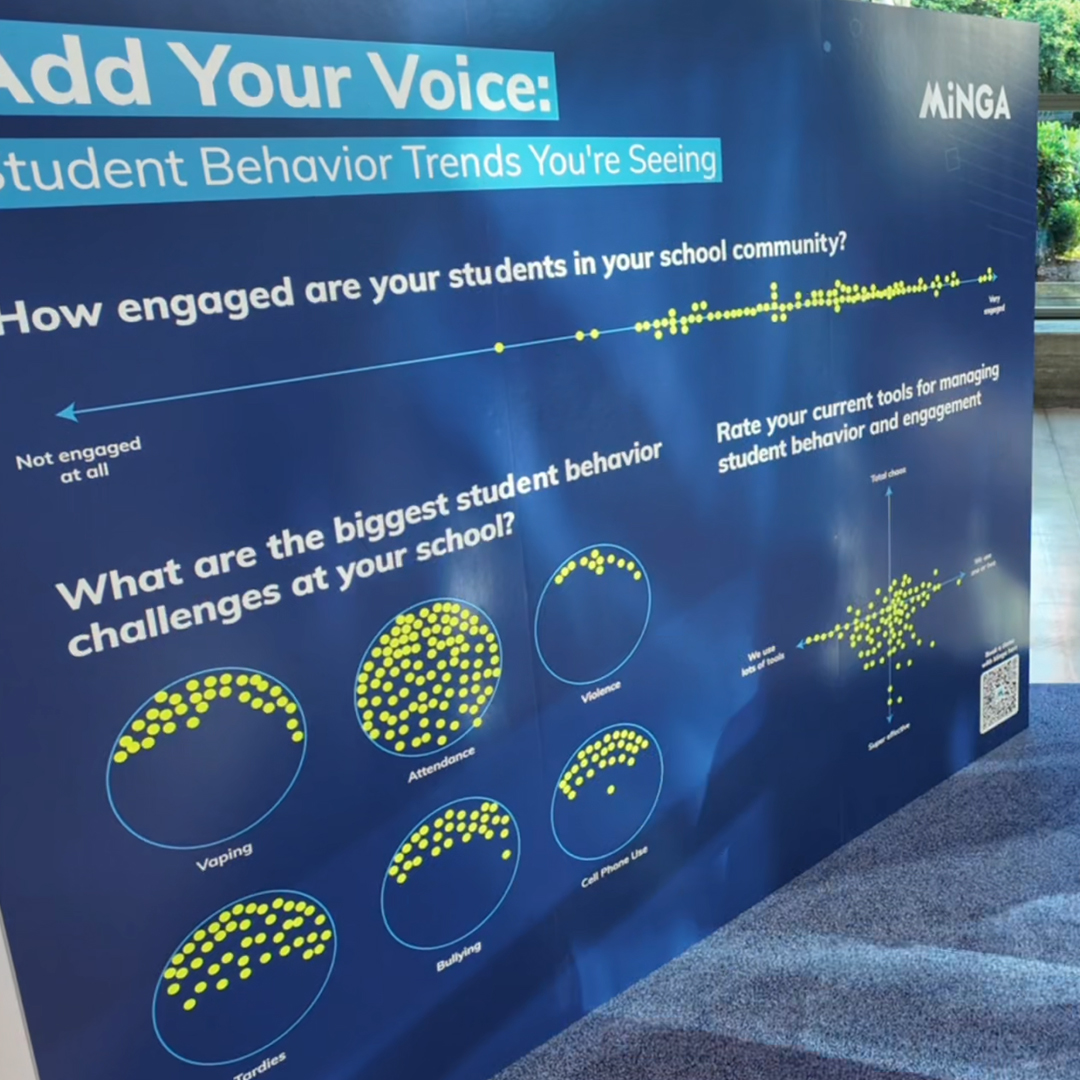
SAN FRANCISCO, CA, UNITED STATES, September 21, 2026 /EINPresswire.com/ — Ask most people what’s wrong in schools today, and they’ll describe a crisis of violence and bullying. New data from Minga, the Student Behavior & Engagement Platform used by 2,500+ schools nationwide, says that assumption doesn’t hold up. Across four separate education conferences in 2026, spanning Texas, Florida, and California, Minga asked thousands of school leaders directly what their biggest behavior challenges actually were. At every single event, bullying, violence, and cyberbullying ranked at or near the bottom of the list. Attendance and tardiness ranked first or second every time, by a wide margin.
At the Texas Association of Secondary School Principals Summer Workshop, attendance and tardies together drew more than double the responses of any other category, while cyberbullying came in dead last. At FETC, the national ed-tech conference held in Orlando, attendance topped the list at over 260 responses, more than nine times the number for violence, the lowest-ranked category. At CADA in California, attendance led again, with cyberbullying trailing far behind. The pattern repeated in every room, regardless of state or the size of the school leading it.
“Nobody in this room is describing a crisis,” said Jason Richards, CEO of Minga. “They’re describing a slow stall. Students are showing up to the building, but not to the culture. They’re disengaging. That’s a much quieter problem than violence, and a much easier one to miss.”
When asked separately how engaged their students actually feel, school leaders gave a strikingly consistent answer: most aren’t reporting a crisis of disconnection, but they aren’t reporting real belonging either. At the Texas event, 59% of leaders placed their students in the “neutral middle,” physically present but not fully invested. At CADA, that number climbed to 74%. Very few leaders, anywhere, described their students as fully checked out. Almost none described them as fully engaged either.
The data also suggests the problem is getting worse, not better. Minga ran the same survey at UNITED 2025 in Seattle and again at FETC 2026 in Orlando, and attendance-related concerns climbed roughly 24% between the two.
Underneath it all is the same explanation, repeated at every event: leaders already want to run preventive, relationship-first schools, but the tools they’re running on don’t support it. Nearly half of Texas principals described their approach as preventive, yet a meaningful share of them are still tracking that intent on spreadsheets. At the DASA 2026 conference, when leaders were asked what specifically made tardiness hard to manage, the top answer, cited by 37% of respondents, was not a student problem at all. It was the absence of a consistent policy.
“The fix isn’t complicated,” said Jason Richards, CEO of Minga. “A consistent policy, applied the same way in every classroom, closes that gap fast. We’ve seen it happen in a matter of months, not years.”
Heading further into the 2026-27 school year, everyone’s bracing for a loud crisis while the quiet one is already unfolding on campus.
ABOUT MINGA
Minga is an educational partner and unified platform designed to help K-12 schools streamline their operations. Used by over 2,500 schools nationwide, Minga provides the foundation for a better school culture by protecting instructional time and fostering student belonging. For more information, visit minga.io.
Giuseppe Simpatico
Minga Solutions Inc
+1 250-864-2949
email us here
Visit us on social media:
LinkedIn
Instagram
Facebook
YouTube
Legal Disclaimer:
EIN Presswire provides this news content “as is” without warranty of any kind. We do not accept any responsibility or liability
for the accuracy, content, images, videos, licenses, completeness, legality, or reliability of the information contained in this
article. If you have any complaints or copyright issues related to this article, kindly contact the author above.

Media gallery

