
Michigan Gala trial data shows how apple trees can carry more fruit without sacrificing size
What makes this trial interesting is the combination of outcomes - more fruit, larger average fruit and greater
Press Release Disclaimer: This is a press release distributed through the XPR Media network. It has not been independently verified by our newsroom.

LANSING, MI, UNITED STATES, September 10, 2026 /EINPresswire.com/ — Apple growers rarely evaluate yield in isolation. A heavier crop is only useful if fruit size remains commercially acceptable and the tree carries that crop efficiently. A 2025 Michigan trial on mature Gale Gala apples therefore asked whether a seaweed extract increases crop load without imposing the usual size penalty.
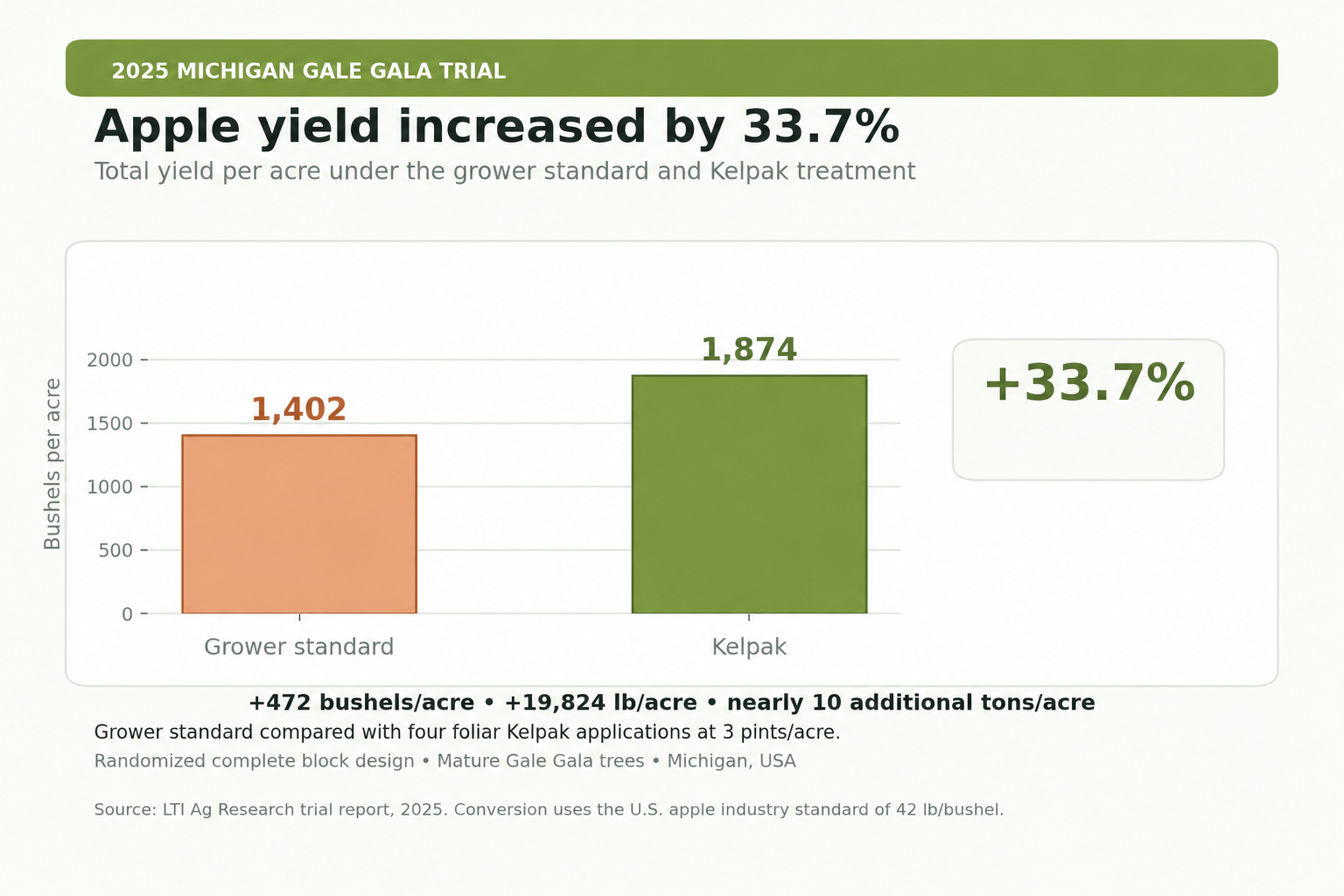
Trees receiving Kelpak produced 1,874 bushels per acre, compared with 1,402 bushels under the grower standard. That represents 472 additional bushels, or a 33.7% increase. Using the U.S. apple industry’s standard 42-pound bushel, the difference equates to 19,824 pounds per acre.
Kelpak is a liquid concentrate made from fresh Ecklonia maxima, a giant brown seaweed that grows in the cold Atlantic waters off South Africa. The kelp is harvested in managed strips, leaving the holdfast attached for regrowth, and processed with proprietary Cellburst technology. High-pressure differentials rupture the kelp cells without heat, freezing or harsh chemicals, helping retain naturally occurring plant compounds in the liquid extract.
The product is not intended to replace fertilizer, irrigation, thinning, pest management or other orchard fundamentals. Applied at defined phenological stages, it supports natural plant processes during periods when fruit set, cell division, and early fruit development influence final crop performance.
LTI Ag Research conducted the trial on Gale Gala trees planted in 2014. It used a randomized complete block design and compared the grower standard with four foliar applications of Kelpak at 3 pints per acre in 40 gallons of spray volume
More important than raw yield was what happened after tree size was taken into account. Orchard trees vary in trunk size and bearing capacity, so yield efficiency based on trunk cross-sectional area, or TCA, offers a more meaningful comparison than pounds per tree alone.
Kelpak increased weight-based yield efficiency from 15.8 to 19.7 pounds per square inch of TCA, a 24.7% improvement. Count-based efficiency rose from 45.9 to 49.6 fruit per square inch of TCA, an 8.1% increase. Both differences were statistically significant in the trial.
At the same time, average fruit weight increased from 144.1 to 163.4 grams, a statistically significant gain of 13.4%. Fruit number rose from 134 to 157 per tree, or 17.2%. The overall result was therefore not simply more fruit, but increased production alongside a significant improvement in size and yield efficiency.
“The tension in apple production is that growers need enough fruit to drive yield, but excessive crop load can reduce fruit size and weaken return bloom,” says Linda Greyling, Head of Technical Support. “What makes this trial interesting is the combination of outcomes – more fruit, larger average fruit and greater production relative to tree size. That gives growers a more useful agronomic signal than yield alone.”
One trial cannot predict performance across every rootstock, soil, season or crop-load strategy. Replication across production regions will be important. Yet the Michigan results raise a worthwhile question for orchard programs: if biological support is timed to the crop’s most sensitive developmental windows, can growers improve the tree’s efficiency, rather than simply asking it to carry more?
Sonja Knoesen
Hatch Communication
+27 83 700 3078
email us here
Legal Disclaimer:
EIN Presswire provides this news content “as is” without warranty of any kind. We do not accept any responsibility or liability
for the accuracy, content, images, videos, licenses, completeness, legality, or reliability of the information contained in this
article. If you have any complaints or copyright issues related to this article, kindly contact the author above.

Media gallery
