
Cell Stem Cell: tBE-mediated Base Editing Therapy Achieves Durable Clinical Remission in Sickle Cell Disease and β-Thalassemia Across Different Genetic Backgrounds
SHANGHAI, Sept. 7, 2026
Press Release Disclaimer: This is a press release distributed through the XPR Media network. It has not been independently verified by our newsroom.

Cell Stem Cell: tBE-mediated Base Editing Therapy Achieves Durable Clinical Remission in Sickle Cell Disease and β-Thalassemia Across Different Genetic Backgrounds
PR Newswire
SHANGHAI, Sept. 7, 2026
Following 100% transfusion independence in Chinese TDT patients, new study confirms tBE is equally safe and effective for African SCD patients and TDT patients from South/Southeast Asia.
SHANGHAI, Sept. 7, 2026 /PRNewswire/ — On September 7, 2026, Shanghai, Cell Stem Cell published online clinical research from CorrectSequence Therapeutics (Correctseq) in collaboration with multiple institutions in a paper titled “Clinical base editing for β-hemoglobinopathies across different genetic backgrounds“, demonstrating that CS-101/CS-206—base-editing therapy developed with the transformer Base Editor (tBE)—achieved consistent efficacy and safety in β-hemoglobinopathy patients of diverse genetic origins. This follows the team’s prior clinical report on five Chinese transfusion-dependent β-thalassemia (TDT) patients treated with CS-101, all achieving transfusion independence (Lai et al., Nature, 2026). The new study extends treatment to four additional patients from Nigeria, Laos, Malaysia, and Pakistan—one with sickle cell disease (SCD) and three with TDT. All achieved rapid hematopoietic reconstitution, sustained high-level pan-cellular HbF expression, complete transfusion independence or freedom from vaso-occlusive crises (VOCs), with no detectable off-target edits, or product-related adverse events.
Broad Applicability Across Various Ethnicities and Mutations
β-hemoglobinopathies are among the most common monogenic disorders, with SCD affecting over 300,000 and TDT over 40,000 newborns annually worldwide. Pathogenic mutations vary significantly across populations. The team previously developed the ultra-high-precision tBE (Wang et al., Nat Cell Biol, 2021) to precisely edit the HBG1/2 promoter region in autologous HSPCs collected from patients, reactivating γ-globin expression. The four patients’ genotypes in the current study encompassed βS/βS SCD and three TDT genotypes—β⁰/βᴱ, β⁰/β⁰ with a large deletion, and β⁰/β⁰ with single-nucleotide insertion—validating the strategy’s universal applicability.
Clinical Data: Rapid Engraftment, Durable Response, Complete Transfusion Independence, and No Off-target Mutations
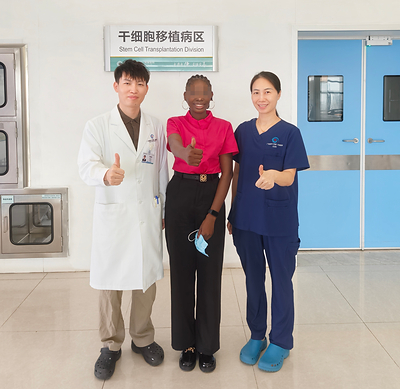
The SCD patient (21-year-old female from Nigeria), who experienced more than four VOCs during the year prior to enrollment, achieved neutrophil and platelet engraftment on days 13 and 21 post-infusion. Total hemoglobin level increased from 7.7 g/dL at baseline to 12.9 g/dL at month 3, remaining above 11 g/dL; HbF level increased from 3.5% to 62.2%, while HbS level decreased from 76.1% to 31.6%, stabilizing at a ~6:4 ratio. At 15.5 months follow-up, no VOCs occurred.
The three TDT patients (ages 3-29, from Laos, Malaysia, and Pakistan) achieved median neutrophil engraftment at 13 days and platelet engraftment at 27 days. Mean total hemoglobin concentration reached 11.6 ± 1.2 g/dL and mean HbF concentration increased to 9.8 g/dL at month 3. At median follow-up of 17.5 months, all achieved sustained transfusion independence. No off-target edits or product-related adverse events were detected.
Comparison with Nuclease-Based Gene Editing Therapies: Faster Engraftment, Higher Expression, Better Safety
In SCD clinical trials, tBE achieved superior neutrophil engraftment (13 days) compared to Cas9 (27 days) and Cas12a (23 days), and superior platelet engraftment (21 days) versus Cas9 (35 days) and Cas12a (25 days). tBE sustained HbF >60% of total hemoglobin, markedly outperforming Cas9 and Cas12a regimens (<50%).
Unlike nucleases that rely on DNA double-strand breaks (DSBs), tBE enables precise base conversion without cutting DNA, avoiding p53 activation, apoptosis, large deletions, and chromosomal rearrangements. Its dual gRNA and “lock-and-key” design further minimizes off-target risks. Through a cleavable “lock”, tBE becomes active only at on-target sites to induce highly efficient editing. When binding at off-target sites, tBE was “locked” to avoid triggering off-target mutations.
Global Progress and Regulatory Pathway
To date, CS-101 and CS-206 have treated more than 30 patients across China, Africa, Southeast Asia, and South Asia, with 100% of patients achieving transfusion independence or freedom from VOCs, accompanied by sustained, high-level hemoglobin expression. CS-101, the world’s first ongoing base-editing therapy candidate to enter clinical development, with the first patient dosed in October 2023, has completed Phase I and is now being evaluated in pivotal trials. All patients treated in Phase I have maintained transfusion independence for more than one year, with the longest duration approaching almost three years.
Professor Chen Jia, founder of Correctseq and Director of the Gene Editing Center at ShanghaiTech University, stated: “This Cell Stem Cell paper validates tBE’s broad applicability across diverse genetic backgrounds, completing the translational journey from bench to global clinical application. Our team is also exploring RNA editing, prime editing, and mitochondrial DNA editing for other therapeutic areas.”
Dr. Mou Xiaodun, CEO of Correctseq, added: “The data demonstrate tBE as a global Best-in-Class platform. We are also expanding into metabolic and cardiovascular diseases including hypertriglyceridemia/familial chylomicronemia syndrome (FCS), ASCVD/hyperlipoproteinemia, homozygous familial hypercholesterolemia (HoFH), and metabolic dysfunction-associated steatohepatitis (MASH). We are accelerating multiple pipelines toward global IND submission to bring China-originated gene editing to more patients worldwide.”
Cell Stem Cell paper link: https://doi.org/10.1016/j.stem.2026.08.009
About CorrectSequence Therapeutics
CorrectSequence Therapeutics (Correctseq), is a clinical-stage biotech company employing its proprietary transformer Base Editor (tBE) to pioneer next-generation gene editing therapies. The company has developed multiple state-of-the-art base-editing systems that offer exceptional precision, minimize off-target effects, and enhance ex vivo and in vivo editing efficiency. Its robust pipeline spans genetic disorders, metabolic diseases, and cardiovascular conditions, with several programs already advancing toward clinical development.
For more information, visit www.correctsequence.com.
Acknowledgments: The First Affiliated Hospital of Guangxi Medical University, ShanghaiTech University, Children’s Hospital of Fudan University, Institutes of Biomedical Sciences, Fudan University, Shanghai Clinical Research and Trial Center.
Media Contact:
Business Cooperation: BD@correctsequence.com
Clinical Trial Recruitment: CT@correctsequence.com
 View original content to download multimedia:https://www.prnewswire.com/news-releases/cell-stem-cell-tbe-mediated-base-editing-therapy-achieves-durable-clinical-remission-in-sickle-cell-disease-and–thalassemia-across-different-genetic-backgrounds-302871478.html
SOURCE CorrectSequence Therapeutics


