Business Travel Market Poised to Cross US$ 10.15 Billion Valuation by 2035 at a Robust 12.5% CAGR
Corporate travel spend is set to nearly quadruple by 2035, fueled by tech adoption, sustainability, and emerging
Press Release Disclaimer: This is a press release distributed through the XPR Media network. It has not been independently verified by our newsroom.
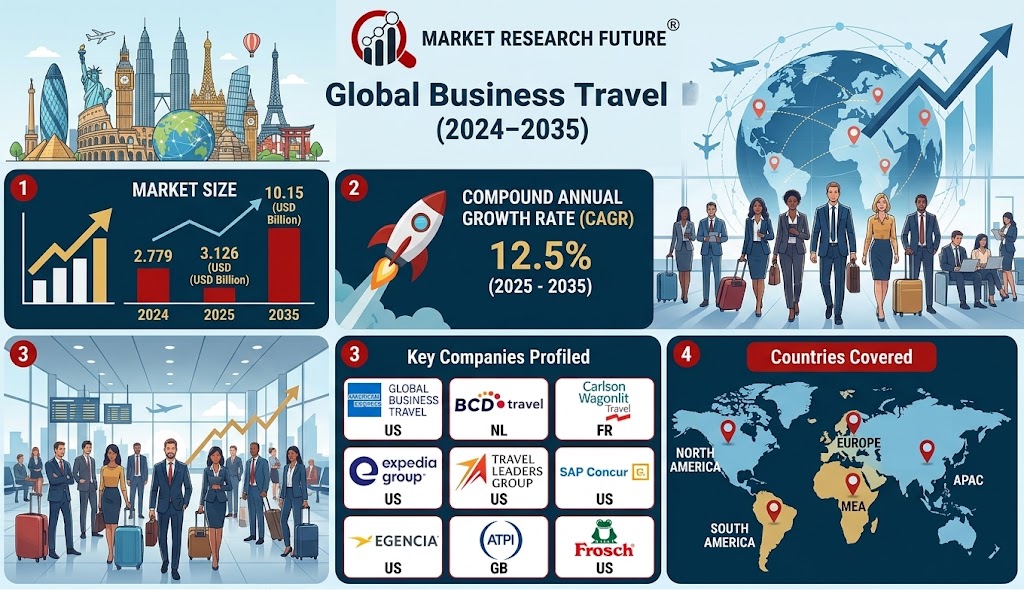

Corporate travel spend is set to nearly quadruple by 2035, fueled by tech adoption, sustainability, and emerging markets.
NEW YORK, NY, UNITED STATES, August 31, 2026 /EINPresswire.com/ — The global Business Travel Market is entering a decade of sustained expansion, with new industry analysis projecting the sector to climb from roughly US$ 2.78 billion in 2024 to nearly US$ 3.13 billion in 2025, before advancing to an estimated US$ 10.15 billion by 2035. That trajectory implies a compound annual growth rate (CAGR) of approximately 12.5% across the 2025–2035 forecast window, underscoring how corporate mobility has moved from a discretionary cost center to a strategic priority for organizations worldwide.
The findings, compiled from a comprehensive review of managed and unmanaged travel programs, corporate spending patterns, and regional business activity, paint a picture of an industry being reshaped simultaneously by stronger corporate earnings, a renewed emphasis on face-to-face engagement, and rapid digitization of the booking and expense-management process. As multinational firms expand into new geographies and mid-market companies re-normalize travel budgets, business travel spending is expected to remain one of the more resilient categories within global corporate expenditure.
Market Overview: A Sector Rebuilding on Stronger Footing
Corporate travel has spent the past several years recalibrating after a period of suppressed demand, and the current data suggests that recalibration is now translating into durable, double-digit growth. Industry estimates place the 2024 market size at roughly USD 2.78 billion, rising modestly to about USD 3.13 billion in 2025 as corporate travel budgets normalize further. From there, the market is forecast to compound at close to 12.5% annually through 2035, a pace that would take the industry past the USD 10 billion mark within the decade.
Request for Free Sample of Report: https://www.marketresearchfuture.com/sample_request/16137
Several forces are converging to support that outlook. Corporate profitability across technology, finance, manufacturing, and professional services has strengthened company travel budgets, while a broader recognition that in-person meetings still drive deal-making, client retention, and cross-border collaboration keeps demand structurally supported even as video conferencing remains widely used. At the same time, emerging economies across Asia, Africa, and Latin America are becoming meaningful contributors to global business activity, generating fresh volumes of trade-show, conference, and client-meeting travel that did not exist at the same scale a decade ago.
Key Trends Shaping the Industry:
Three interlocking trends stand out in the current market landscape.
Sustainability is becoming a procurement criterion, not a marketing talking point. Corporate travel buyers are increasingly steering spend toward lower-emission transportation, certified-green accommodation, and carbon-offset programs as part of broader environmental, social, and governance (ESG) commitments. Travel management companies that can demonstrate measurable sustainability credentials are gaining a competitive edge in enterprise contract negotiations.
Technology is compressing the distance between booking and insight. Mobile-first booking tools, artificial-intelligence-assisted itinerary planning, and real-time spend analytics are replacing older, manual travel-approval workflows. This is not simply a convenience upgrade — it is materially reducing the administrative overhead of running a corporate travel program while giving finance and procurement teams far more granular visibility into where travel dollars are going.
Personalization is redefining what a “managed” travel program looks like. Rather than rigid, one-size-fits-all policies, more organizations are building flexible frameworks that let individual employees tailor routing, lodging, and even leisure add-ons around required business trips, while still keeping spend within policy guardrails. This shift is closely tied to broader workforce well-being priorities, as companies compete for talent partly on the basis of how humane and flexible their travel policies are.
Growth Drivers: Why the Market Is Accelerating
Rising corporate profitability. As earnings strengthen across sectors — particularly technology and financial services — companies are reinvesting a portion of that profitability into employee travel for client-facing and relationship-building activity. Corporate travel spending broadly is expected to grow at a mid-single-digit rate over the next several years even before accounting for the specific dynamics of the business travel segment, reinforcing the case for continued investment in travel infrastructure and services.
Expansion of emerging markets. Faster-growing economies in Asia-Pacific, parts of Africa, and Latin America are contributing an outsized share of incremental global economic growth, and that expansion is translating directly into new travel requirements for meetings, trade shows, and market-entry activity. International bodies have flagged emerging markets as likely to account for the majority of global GDP growth in the years ahead, a dynamic that directly benefits business travel volumes in those regions.
Employee well-being and retention pressure. A large share of the workforce now expects employers to actively manage the toll that frequent travel can take, and companies are responding with more flexible booking windows, upgraded lodging standards, and “bleisure” (business-plus-leisure) options. Organizations that get this right are better positioned to retain the traveling talent that drives revenue-generating activity.
Sustainability and corporate responsibility commitments. A majority of business travelers now say they prefer working with organizations that can show a genuine commitment to environmentally responsible travel, pushing procurement teams to favor suppliers with credible sustainability programs.
Technology-driven cost control. Organizations deploying modern travel-management platforms are reporting meaningful reductions in overall travel spend — reinforcing the business case for continued technology investment even as overall travel volumes rise.
Market Segmentation: Where the Growth Is Concentrated
The Business Travel Market is segmented across type, purpose, expenditure category, traveler age group, traveler configuration, service category, and industry vertical — each offering a distinct view of where demand is concentrated and where it is accelerating fastest.
By Type — Managed vs. Unmanaged Travel: Managed business travel remains the larger of the two categories, reflecting corporate preference for centralized policy control, negotiated rates, and duty-of-care compliance. Unmanaged travel, however, is growing at a noticeably faster clip, propelled by remote and hybrid work arrangements that give employees more autonomy over how and when they book trips, along with the proliferation of consumer-grade booking apps that make independent travel arrangements easier than ever.
By Purpose — Internal Meetings, Marketing, Trade Shows, and Product Launches: Internal meetings continue to represent the largest share of business-travel purpose, reflecting the enduring importance of in-person collaboration across distributed teams. Trade shows and product launches follow closely behind. Marketing-related travel — trips built around brand-building, client engagement, and experiential outreach — is the fastest-expanding purpose category, as companies lean into face-to-face relationship building to differentiate themselves in competitive markets.
By Expenditure — Lodging, Dining, Fares, and Other Costs: Lodging remains the single largest expenditure line within business travel budgets, with corporate lodging spend estimated in the low single-digit billions of dollars for 2025 alone, as companies prioritize comfortable, well-located accommodation to support traveler productivity. Dining is the fastest-growing expenditure category, with spend estimated in the mid-single-digit billions for 2025, reflecting the rising importance placed on business meals and client entertainment. Marketing travel fare — covering transportation costs tied specifically to marketing-purpose trips — is also a meaningful and growing expenditure line.
By Age Group — Below 40 vs. Above 40: Travelers under 40 account for the largest share of business travel activity, with market value for this cohort estimated at roughly USD 5.5 billion in 2025, driven by their comfort with digital booking tools and openness to new destinations and travel formats. Travelers above 40, meanwhile, represent the fastest-growing age segment, as more experienced professionals take on expanded travel responsibilities tied to senior client relationships and cross-border deal-making.
By Traveler Configuration — Group vs. Solo: Group travel — encompassing conferences, corporate retreats, and team-building trips — remains the larger category, with an estimated market value approaching USD 3.15 billion in 2025. Solo travel is expanding at a faster pace, estimated at roughly USD 4.25 billion in 2025, as more professionals opt for individualized itineraries built around specific client or project objectives.
By Service — Food and Lodging vs. Recreation Activities: Food and lodging services continue to anchor the overall service segment, given their essential role in every business trip. Recreation activities, while still a smaller share of overall spend, are gaining traction as more organizations build wellness and downtime elements into travel itineraries to support traveler morale.
By Industry — Corporate vs. Government: Corporate travel dominates the industry segment, with an estimated value of roughly USD 7 billion in 2025, reflecting the sheer scale of client meetings, training, and operational travel undertaken by private-sector organizations. Government travel, valued at an estimated USD 3.1 billion in 2025, is the faster-growing of the two categories, buoyed by expanding public-sector programs and cross-agency initiatives that require increased travel.
Regional Insights: North America Leads, Asia-Pacific Accelerates
North America continues to hold the largest share of the global Business Travel Market, a position underpinned by the sheer concentration of multinational corporate headquarters in the region, well-developed travel infrastructure, and an increasing corporate emphasis on employee well-being during travel.
Europe holds the second-largest regional share, supported by dense intra-regional business networks and the continent’s long-standing role as a global commercial hub. Within Europe, Germany represents the largest national market, while the United Kingdom stands out as the fastest-growing.
Asia-Pacific, meanwhile, is set to post the fastest regional growth rate over the coming years, a reflection of rapid economic expansion, a swelling volume of business events, and rising foreign direct investment across the region. China represents the largest national market within Asia-Pacific, while India has emerged as the fastest-growing, consistent with its expanding role as a hub for corporate investment and cross-border commercial activity.
The Rest of the World region, spanning Latin America, the Middle East, and Africa, remains a smaller but steadily developing contributor to overall market volume, with growth tied closely to expanding trade relationships and infrastructure investment.
Competitive Landscape: Established Players Double Down on Technology
The Business Travel Market remains led by a group of established travel-management specialists and diversified travel platforms, including American Express Global Business Travel, BCD Travel, Carlson Wagonlit Travel, Expedia Group, Travel Leaders Group, SAP Concur, Egencia, ATPI, and Frosch. Together, these organizations account for a substantial share of managed corporate travel volume worldwide, and each has continued to invest heavily in platform technology, traveler-safety tools, and sustainability reporting capabilities to defend and grow market share.
Recent competitive activity underscores how central technology partnerships and strategic alliances have become to the sector. BCD Travel has deepened its collaboration with major global-distribution and technology partners to refine its travel-management offering for a new era of corporate travel needs. Corporate Travel Management (CTM) continues to expand its footprint through a client-centric, regionally tailored program-design model, while CWT has broadened long-standing enterprise partnerships to manage travel programs for large multinational clients. Elsewhere, Priceline has partnered with major cloud providers to bring generative-AI-powered trip planning and neighborhood-level destination insights to travelers, and Flight Centre Travel Group has established a dedicated internal division focused on embedding artificial intelligence across its corporate travel operations, aiming to improve both traveler experience and internal efficiency. Smaller specialists such as Ovation Travel Group and Travel Leaders Group have likewise reported strong rebounds in corporate booking volumes alongside new mobile and partnership-driven offerings, pointing to a broad-based recovery across the competitive set rather than gains concentrated among just a handful of dominant players.
Beyond the core managed-travel specialists, a wider set of travel platforms — including large online travel agencies and hospitality marketplaces — continue to compete for corporate wallet share by expanding product lines, deepening loyalty programs, and building out business-specific booking tools, further intensifying competition across the value chain.
Future Outlook: A Decade of Technology-Led Expansion
Looking ahead through 2035, the Business Travel Market is expected to be defined by three structural shifts: deeper integration of AI-driven travel-management platforms into everyday booking and expense workflows; continued expansion of sustainable travel options tailored specifically for corporate clients; and the use of data analytics to build increasingly personalized travel experiences at scale. Companies that can combine cost discipline with a genuinely improved traveler experience are likely to be best positioned to capture share as the market approaches the USD 10 billion mark over the next decade.
For corporate travel managers, procurement leaders, and investors evaluating the sector, the underlying message is consistent: business travel has re-established itself as a durable, growing category — one increasingly shaped by technology, sustainability commitments, and a more personalized approach to how, when, and why employees hit the road.
Browse More Reports:
Travel Retail Market
https://www.marketresearchfuture.com/reports/travel-retail-market-11814
B2B Travel Market
https://www.marketresearchfuture.com/reports/b2b-travel-market-23158
Incentive Travel Market
https://www.marketresearchfuture.com/reports/incentive-travel-market-33762
Market Research Future
Market Research Future
+1 855-661-4441
email us here
Legal Disclaimer:
EIN Presswire provides this news content “as is” without warranty of any kind. We do not accept any responsibility or liability
for the accuracy, content, images, videos, licenses, completeness, legality, or reliability of the information contained in this
article. If you have any complaints or copyright issues related to this article, kindly contact the author above.

Media gallery