Assisted Reproductive Technology Market to reach USD 73.04 Billion by 2035 at 8.4% CAGR
Assisted Reproductive Technology Market to Surge from USD 32.60 Bn in 2025 to USD 73.04 Bn by 2035—By Rising
Press Release Disclaimer: This is a press release distributed through the XPR Media network. It has not been independently verified by our newsroom.
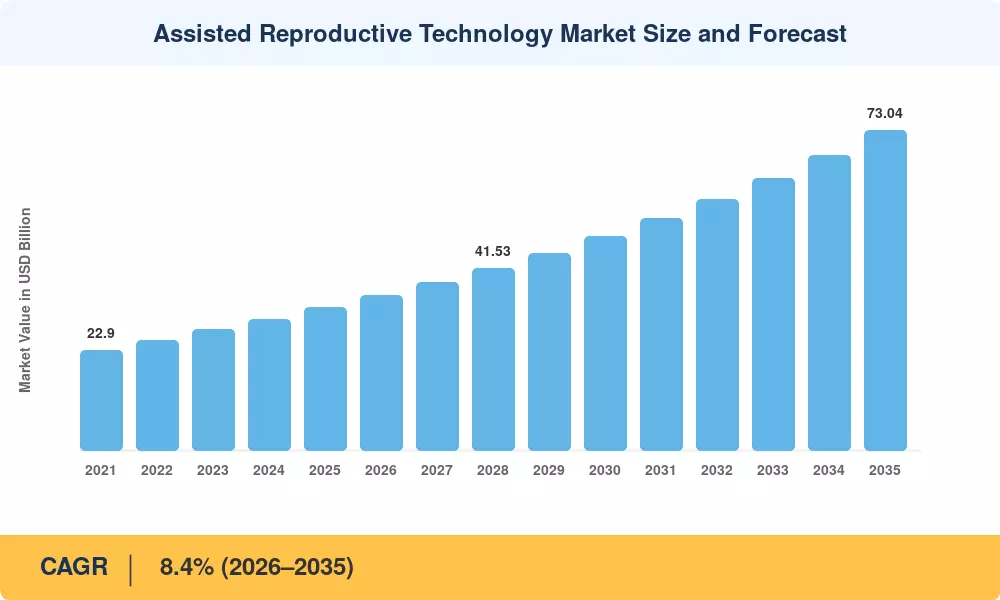

Assisted Reproductive Technology Market to Surge from USD 32.60 Bn in 2025 to USD 73.04 Bn by 2035—By Rising Infertility Prevalence, Employer Benefit Expansion
NY, CA, UNITED STATES, August 27, 2026 /EINPresswire.com/ — As per Market Research Future, the global Assisted Reproductive Technology Market size is projected to reach USD 73.04 Billion by 2035 from USD 32.60 Billion in 2025, at a CAGR of 8.4% during the forecast period 2026–2035. The market value is expected to reach USD 35.34 Billion in 2026 as the first year of the forecast period.
The 8.4% CAGR—anchored by structural shifts in fertility care—is propelled by three converging forces: the rising global prevalence of infertility, with the World Health Organization estimating that roughly one in six adults experiences infertility at some point, reframing the category from elective to essential care and strengthening the case for insurance coverage and public health investment worldwide; expanding public insurance reimbursement, particularly China’s National Healthcare Security Administration extending provincial insurance reimbursement to 17 assisted conception items beginning in Beijing in July 2023, a policy replicated across more than 20 provinces, significantly widening patient access to fertility treatment across China; and a broader clinical shift toward higher-efficiency embryo culture and selection technologies, including vitrification, blastocyst culture, elective freeze-all cycles, time-lapse incubators, and AI-scored morphokinetics that have replaced manual embryo grading, improving endometrial receptivity and reducing hyperstimulation risk.
Global pharmaceutical companies and health organizations are amplifying this momentum. CooperSurgical holds an estimated 11–14% revenue share with the broadest end-to-end laboratory portfolio spanning media, incubators, witnessing, and genetic testing. Vitrolife Group commands approximately 9–12% share with its evidence-led premium lab standard in culture media and time-lapse systems. Merck KGaA and Ferring Pharmaceuticals have jointly committed more than USD 400 million to fertility research and development and manufacturing capacity between 2023 and 2025. According to WHO data, roughly one in six adults worldwide experiences infertility, while OECD data place mean maternal age at first birth above 29 years in most member states, with Italy, Spain, and Korea exceeding 31. These forces are creating the clinical infrastructure and patient demand on which the Assisted Reproductive Technology Market depends.
Request A Free Sample:
https://www.marketresearchfuture.com/sample_request/6359
Key Market Trends & Growth Drivers
Rising Infertility Prevalence and Delayed Parenthood
The market is witnessing increasing demand driven by demographic shifts. Age at first birth keeps climbing across OECD economies, and biology has not adjusted. OECD data place mean maternal age at first birth above 29 years in most member states, with Italy, Spain, and Korea exceeding 31. The WHO’s 2023 synthesis put lifetime infertility prevalence near 17.5%, with little variation between high- and low-income settings. Demand is therefore structural rather than cyclical, with more individuals seeking effective assisted conception interventions. This trend indicates a shift in societal attitudes toward proactive family planning, with ART being recognized for its essential role in addressing both male-factor and unexplained infertility. CooperSurgical continues advancing product development through next-generation laboratory portfolios while strengthening strategic partnerships supporting fertility treatment research.
Expanding Insurance Coverage and Employer Benefits
Innovations in payer economics are becoming a hallmark of the industry. Payer economics decide whether intent becomes a booked cycle. Kaiser Family Foundation’s 2024 employer survey found that 47% of US firms with 200 or more workers cover in-vitro fertilization, up sharply from 2020. Israel’s state-funded model, covering treatment to two live births, sustains the world’s highest per-capita cycle rate. Coverage design, not clinical capability, is the binding constraint in most geographies. These advancements aim to enhance patient access and affordability, potentially leading to better health outcomes and increased market penetration. Employer-sponsored fertility benefits accounted for significant revenue growth in North America, driven by specialized benefit managers such as Progyny steering volume toward contracted centres of excellence.
Vitrification and Freeze-All Protocol Adoption
The incorporation of advanced cryopreservation technologies into the industry is gaining traction. Vitrification survival rates above 95% made freeze-all viable, and freeze-all made single-embryo transfer defensible. HFEA reported that frozen cycles overtook fresh cycles in the UK during 2022. Vitrolife and CooperSurgical have both repositioned around media, time-lapse systems, and electronic witnessing rather than one-off capital sales. Consumables now travel with every cycle, which is why laboratory spend compounds faster than clinic count. Tools such as time-lapse incubators and AI-scored morphokinetics are being utilized to monitor embryo development and facilitate communication between embryologists and clinicians, enhancing treatment outcomes.
Clinic Network Consolidation and Private Capital
The rising incidence of infertility coupled with fragmented service delivery is a primary driver. Private equity and strategic buyers have consolidated fragmented single-site practices into multi-country platforms. Nordic Capital’s acquisition of Care Fertility in 2023 and KKR’s ownership of IVIRMA Global illustrate the scale ambition. Consolidated groups negotiate better consumable pricing, standardise protocols, and publish comparable outcome data, which in turn accelerates payer contracting. The market is projected to expand as healthcare providers increasingly adopt ART medications and technologies to manage fertility challenges. The World Health Organization has identified infertility as a global health priority, underscoring the urgent need for innovative solutions.
Ask for Customization:
https://www.marketresearchfuture.com/ask_for_customize/6359
Market Segment Insights
BY TECHNOLOGY
In-Vitro Fertilization (incl. ICSI): Largest segment with 62.4% share in 2025, driven by male-factor and unexplained infertility volume. CooperSurgical continues expanding IVF technology portfolios through sustained product innovation.
Cryopreservation & Gamete Banking: Fastest-growing segment at 11.2% CAGR, appealing to patients seeking elective and oncofertility preservation. Kitazato Corporation leads in vitrification protocols.
Frozen Embryo Replacement: Positioned as a structural share gainer, generating USD 6.85 Billion in 2025, driven by freeze-all protocol adoption that converts a one-transfer cycle into a multi-transfer asset.
BY END USER
Fertility Clinics: Largest segment with 58.6% share in 2025, benefiting from specialised, high-throughput laboratories. IVIRMA Global continues strengthening clinic network consolidation through portfolio expansion.
Hospitals & Surgical Centres: Significant share at USD 8.32 Billion in 2025, due to integrated obstetrics and oncology referral pathways and direct access to patients requiring specialised treatment.
Cryobanks: Fastest-growing end-user channel at 12.3% CAGR, gaining traction among patients seeking long-duration storage contracts and annuity-like revenue streams.
BY PROCEDURE TYPE
Fresh Non-Donor: Largest segment with 44.8% share in 2025, due to its position as the standard first-cycle pathway for most patients.
Frozen Non-Donor: Fastest-growing procedure segment, generating USD 11.15 Billion in 2025, as freeze-all and sibling-transfer cycles continue to expand.
Fresh Donor: Smaller but significant share at 9.6% CAGR, reflecting a growing advanced maternal age caseload and cross-border reproductive care flows.
BY OFFERING
Reagents, Media & Consumables: Dominant offering with 41.5% share in 2025, offering robust per-cycle recurring consumption and established preference among laboratory operators.
Instruments & Equipment: Significant share at USD 9.16 Billion in 2025, driven by incubator and micromanipulation refresh cycles.
Accessories & Disposables: Fastest-growing offering at 9.8% CAGR, positioning itself as an appealing alternative for single-use safety requirements.
Read Detailed Insights:
https://www.marketresearchfuture.com/reports/assisted-reproductive-technology-market-6359
Regional Outlook
North America — Market Leader in Innovation
North America leads with 34.0% of global revenue in 2025, generating around USD 11.08 Billion. The region’s growth is driven by expanding employer-sponsored fertility benefits, rising infertility awareness, and favorable reimbursement policies. According to Kaiser Family Foundation, 47% of US firms with 200 or more workers now cover in-vitro fertilization. The competitive landscape is characterized by continuous network consolidation and strategic partnerships among leading fertility clinic platforms.
Europe — Second Largest Market
Europe was valued at USD 9.62 billion in 2025, representing the second-largest regional market with a 29.5% share. The region benefits from increasing cross-border donor programmes and supportive healthcare policies. Regulatory bodies like the EMA and HFEA are actively facilitating the approval of new therapies. Leading countries include Spain, the United Kingdom, and Germany, where major companies such as Vitrolife and IVIRMA Global are heavily invested.
Asia-Pacific — Rapidly Growing Market Segment
The Asia-Pacific region accounts for a significant share of the global market. The growth is driven by rising infertility rates, state reimbursement rollouts, and increasing healthcare access. Countries like China and Japan are experiencing a surge in demand, supported by government initiatives aimed at improving healthcare infrastructure. China’s provincial insurance inclusion and Japan’s April 2022 national health insurance coverage decision have materially widened the funded patient pool. The competitive landscape is evolving with companies like Merck KGaA and Ferring Pharmaceuticals leading the charge.
South America — Emerging Opportunity
The South America region holds around 5.5% of the global share, driven by increasing awareness of infertility treatment and rising healthcare investments. Brazil leads the region with its private clinic network scale, while Argentina’s national law mandating coverage remains the region’s most progressive framework. Countries like Brazil and Argentina are leading the way, with a growing presence of international pharmaceutical companies.
Middle East and Africa — Untapped Potential
The MEA region reached USD 1.14 Billion in 2025, driven by increasing awareness of infertility, medical tourism, and rising healthcare investments. The United Arab Emirates leads with medical tourism and mandatory insurance, while Saudi Arabia advances at 11.8% CAGR through Vision 2030 healthcare investment. Israel’s fully funded model continues to produce the highest cycles-per-capita figure worldwide.
Competitive Landscape and Recent Developments
The Assisted Reproductive Technology market is characterized by intense competition and rapid growth, driven by increasing prevalence of infertility worldwide. The global industry appears moderately fragmented on the clinic side, with several key vendors exerting significant influence on the supply side.
KEY COMPANIES AND RECENT MILESTONES
CooperSurgical (US): Holds an estimated 11–14% revenue share with the broadest end-to-end laboratory portfolio spanning media, incubators, witnessing, and genetic testing. In September 2024, broadened its electronic witnessing and traceability offering in response to European laboratory accreditation expectations.
Vitrolife Group (SE): Commands approximately 9–12% share with its evidence-led premium lab standard in culture media and time-lapse systems. In May 2024, expanded its time-lapse and genetic testing portfolio integration, tightening the link between imaging data and embryo selection workflows.
Merck KGaA (DE) (March 2025): Announced additional fertility manufacturing and digital decision-support investment aimed at standardising stimulation protocols across networks. Holds approximately 8–11% revenue share with its gonadotropins and fertility hormone portfolio.
Ferring Pharmaceuticals (CH) (June 2025): Extended reproductive medicine partnerships across Asia-Pacific to support reimbursed-cycle demand in Japan and China. Holds approximately 6–9% revenue share with deep reproductive medicine specialisation.
Other Key Players: Thermo Fisher Scientific (US), Kitazato Corporation (JP), Esco Medical (SG), Hamilton Thorne (US), IVIRMA Global (ES), Monash IVF Group (AU).
Future Outlook: 2026–2035
The Assisted Reproductive Technology Market is projected to reach USD 73.04 billion by 2035, growing at a CAGR of 8.4%, driven by increasing infertility prevalence, expanding insurance coverage, and advancements in laboratory technologies.
New opportunities lie in:
Expansion into emerging markets with affordable sub-USD 3,000 cycle models
Development of AI-assisted embryo selection and outcome data monetisation platforms
Investment in fertility preservation as a standalone franchise for oncofertility and elective preservation
Cross-border reproductive care corridors in Europe, Middle East, and Asia-Pacific
Platform economics reaching the clinic through scheduling, financing, pharmacy, storage, and benefits administration
By 2035, the Assisted Reproductive Technology Market is expected to achieve substantial growth and innovation, with market leadership belonging to whoever succeeds in industrializing laboratory-scale embryo processing.
More Related Research Insights:
https://www.marketresearchfuture.com/reports/amniotic-membrane-market-5645
https://www.marketresearchfuture.com/reports/in-vitro-fertilization-market-2289
https://www.marketresearchfuture.com/reports/enteral-feeding-devices-market-7828
https://www.marketresearchfuture.com/reports/organ-on-chip-market-8498
https://www.marketresearchfuture.com/reports/blood-culture-test-market-9031
https://www.marketresearchfuture.com/reports/microrna-market-21849
https://www.marketresearchfuture.com/reports/healthcare-it-market-5950
https://www.marketresearchfuture.com/reports/decentralized-clinical-trials-market-43170
https://www.marketresearchfuture.com/reports/catheters-market-3186
https://www.marketresearchfuture.com/reports/pulmonary-arterial-hypertension-market-22006
Market Research Future
Market Research Future
+1 855-661-4441
email us here
Legal Disclaimer:
EIN Presswire provides this news content “as is” without warranty of any kind. We do not accept any responsibility or liability
for the accuracy, content, images, videos, licenses, completeness, legality, or reliability of the information contained in this
article. If you have any complaints or copyright issues related to this article, kindly contact the author above.

Media gallery